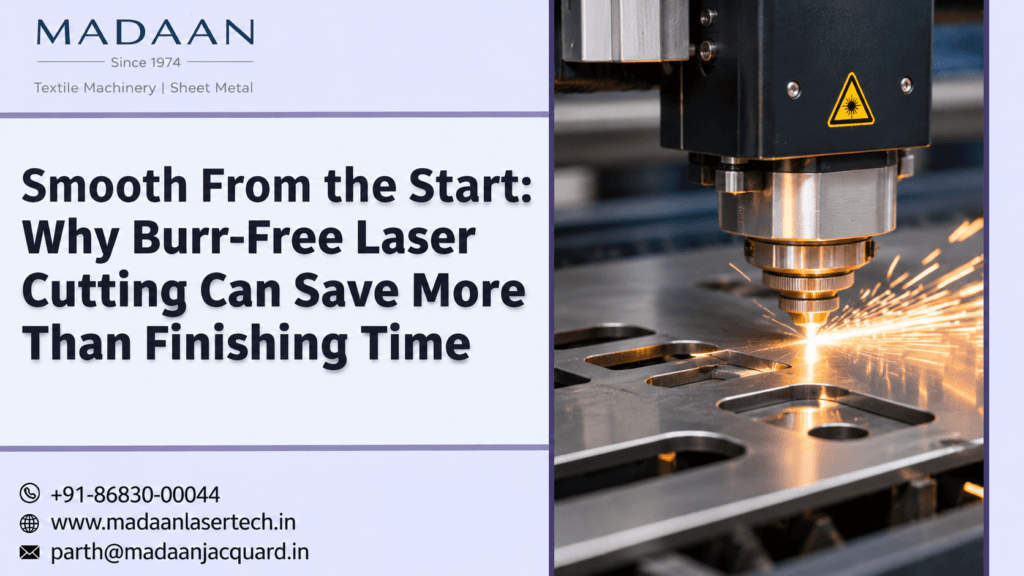
A component can be dimensionally correct and still cause production friction. Anyone who has manually ground hundreds of sharp metal edges knows burrs create handling delays, safety hazards, extra labor and inconsistency across repeat production runs. Edge quality deserves far more attention than it typically receives.
For buyers seeking burr-free metal laser cutting in India, the primary value is not just visual appeal but the elimination of unnecessary secondary processing downstream.
First: What Exactly Is a Burr?
A burr is unwanted material remaining along the edge of a part after cutting.
Depending on the process, it may appear as:
- A sharp ridge
- Small projections
- Dross on the lower edge
- Rough material around holes
- Uneven cut residue
Some burrs are obvious.
Others become painfully obvious only when someone handles the component.
Why Do Burrs Matter?
The cutting table is rarely the final stop.
A part may still have to be:
Bent → Welded → Coated → Handled → Assembled
Rough edges can interfere with several of these stages Rough edges directly impact these downstream operations:
| Problem | Possible Production Impact |
|---|---|
| Sharp edges | Handling and safety concerns |
| Heavy dross | Extra grinding |
| Uneven mating edge | Poor fit during assembly |
| Rough coating surface | Less consistent finished appearance |
| Burr around holes | Fastener or alignment difficulty |
| Manual deburring | Added labour and lead time |
Clean cutting delivers value far beyond the laser machine itself.
What Creates a Cleaner Laser-Cut Edge?
Several variables work together.
Material
Mild steel, stainless steel, and aluminum react differently to thermal energy and require tailored cutting strategies.
Thickness
A thin sheet and a thick plate demand different cutting conditions.
Focus
The laser needs to deliver energy appropriately through the material thickness.
Assist Gas
Assisting gases blow molten material from the kerf, directly influencing dross formation.
Speed
Too fast can compromise the cut. While too slow can add unnecessary heat.
Machine Parameters
Power, nozzle condition, gas pressure and cutting strategy all influence the outcome.
There is no magical “burr-free” button.
It is a process result.
Burr-Free Does Not Mean Every Cut Is Identical
This is an important distinction.
The achievable edge condition depends on:
- Material
- Thickness
- Geometry
- Surface condition
- Required quality
- Cutting parameters
A delicate stainless-steel panel and a heavy structural plate should not necessarily be judged by identical visual standards.
The question should be:
Is the cut edge suitable for the next manufacturing stage with minimal unnecessary processing?
That is a much more practical definition of quality.
The Hidden Cost of Deburring
Consider a production batch of 1,000 components.
If each part needs only 45 seconds of manual edge finishing:
1,000 × 45 seconds = 12.5 labour hours
And that calculation ignores:
- Material handling
- Tool changes
- Inspection
- Dust extraction
- Rework
- Production scheduling
Again, this is an illustrative example.
The point is simple.
Small finishing operations become large production costs when quantities grow.
Cleaner Edges Can Improve Bending
When parts transition to CNC press brake bending, burr residue around bend lines or gauging points disrupts consistency. Clean profiles means predictable sheet positioning and repeatable bend accuracy across production runs.
Cleaner Edges Can Improve Welding and Fit-Up
Imagine two components that need to be welded together.
If their mating edges are inconsistent or covered in heavy cutting residue, the fabrication team may need to correct them first.
A cleaner profile can support:
- Better fit-up
- More predictable alignment
- Less manual preparation
- More consistent welding
Again, the benefit is not merely visual.
It is operational.
Cleaner Parts Also Help Before Coating
Powder coating cannot mask rough metal preparation. Sharp burrs interrupt film coverage and lead to premature edge corrosion. Smooth edges provide an optimal foundation for durable surface finishing.
| Stage | What We Want |
|---|---|
| Laser cutting | Accurate clean profile |
| Bending | Repeatable geometry |
| Fabrication | Correct fit and alignment |
| Surface preparation | Clean coating-ready surface |
| Powder coating | Consistent finished part |
Each stage inherits the quality of the stage before it.
Where Does Laser Cutting Have an Advantage?
Compared with many conventional cutting methods, modern laser cutting can provide:
- Narrow controlled cuts
- Detailed geometry
- High repeatability
- Limited mechanical deformation
- Reduced secondary processing in suitable applications
Madaan’s current laser-cutting capabilities cover metals including mild steel, stainless steel and aluminium, with processing offered for sheet metal up to 20 mm depending on the material and requirement.
Questions Buyers Should Ask About Edge Quality
Rather than asking if a vendor can cut a part, buyers should evaluate operational edge quality by asking:
- What edge condition can we expect?
- Will the part require grinding afterward?
- Are our holes suitable for this material thickness?
- Will the component move directly into bending?
- Are there critical mating edges?
- Does our finishing requirement change the cutting strategy?
These questions connect cutting quality to production reality.
A Clean Edge is a Productivity Feature
Burr-free cutting is fundamentally a productivity feature. Eliminating edge residue reduces grinding, handling, cycle times, and scrap rates. When sourcing burr-free metal laser cutting in India, evaluate suppliers not just by edge appearance, but by how efficiently parts flow into assembly because the most cost-effective finishing operation is the one you eliminate.