Manufacturing has always had a complicated relationship with speed.
Everyone wants faster production.
Nobody wants 500 incorrect parts delivered faster.
That distinction matters when we talk about modern fiber laser cutting.
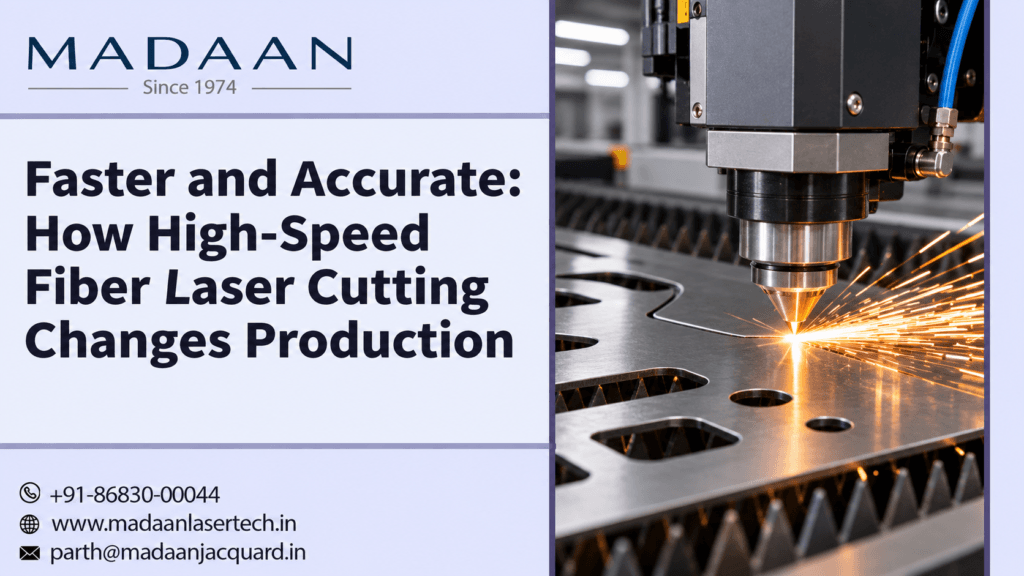
The real advantage of high-speed cutting is not simply that the laser head moves quickly. It is that digital control, focused laser energy, efficient nesting and repeatable processing can shorten production cycles without turning accuracy into a casualty of speed.
For manufacturers evaluating high-speed fiber laser cutting in India, that combination is what matters most.
At Madaan Lasertech, laser cutting forms part of a wider sheet metal manufacturing process that includes CNC bending, fabrication and finishing. So, this gives us a clear understanding that a fast-cut part is only valuable when it is also ready for the next operation.
What Makes Fiber Laser Cutting Fast?
A fiber laser generates and delivers laser energy differently from older cutting technologies. For suitable sheet metal applications, this can provide high energy efficiency and rapid processing.
But machine speed alone does not determine production speed.
| Factor | Why It Matters |
|---|---|
| Laser power | Helps maintain effective cutting across suitable material thicknesses |
| Material type | Different metals respond differently to laser energy |
| Sheet thickness | Thin sheet can generally be processed faster than heavy plate |
| Nesting | Better layouts reduce wasted sheet and machine movement |
| Cutting path | Efficient sequencing reduces unnecessary travel |
| Setup | Correct parameters reduce stoppages and rework |
So, when someone says that the machine is fast. It only solves one part of the problem.
Where Does the Time Saving Actually Come From?
1. No Physical Cutting Tool
Traditional mechanical cutting relies on physical contact.
Fiber laser cutting is a non-contact process.
That means there is no cutting blade repeatedly contacting the workpiece and no corresponding cutting-tool geometry required for every component shape.
Complex profiles can be produced directly from digital manufacturing data.
2. CAD-to-Cut Production
Once the component has been prepared digitally, the cutting machine can follow the programmed geometry.
A design change may therefore require updating the manufacturing file rather than creating an entirely new mechanical cutting tool.
This becomes particularly useful for:
- Prototype development
- Small and medium batches
- Multiple component variants
- Frequently revised industrial parts
3. Faster Changeovers
Modern manufacturing rarely produces one component forever.
A batch of brackets may be followed by enclosure panels, machine covers or mounting plates.
Digital production allows different geometries to be handled with considerably greater flexibility.
Speed Matters Most When Production Volumes Grow
Saving a few seconds on one part does not sound dramatic.
Multiply that across thousands of components and the picture changes.
Imagine:
| Scenario | Cutting Time per Part | 2,000 Parts |
|---|---|---|
| Process A | 60 sec | 33.3 hours |
| Process B | 42 sec | 23.3 hours |
| Difference | 18 sec | 10 hours |
This is just an illustration that shows how a relatively small saving per component can create meaningful production capacity when volumes increase.
But Cutting Speed Has a Limit
More speed is not automatically better.
If cutting parameters become too aggressive for the material or thickness, you may see:
- Poor edge quality
- Incomplete cuts
- Excessive dross
- Dimensional inconsistency
- More secondary finishing
At that point, the “faster” process becomes slower because additional work is required afterward.
Our objective is therefore not maximum machine speed.
It is optimum production speed.
That means balancing:
Speed + Accuracy + Edge Quality + Repeatability
Nesting is the Quiet Productivity Tool
High-speed machinery receives most of the attention.
Nesting receives considerably less.
Yet how components are arranged on a sheet can affect material consumption and overall cutting efficiency.
Good nesting tries to:
- Fit more parts onto the available sheet
- Reduce unnecessary scrap
- Minimise machine travel
- Maintain suitable spacing
- Support stable cutting sequences
Think of it as industrial Tetris.
Except every empty space costs money.
What Happens After the Laser Is Just as Important
A laser-cut component may still need:
Cutting → Bending → Welding → Powder Coating → Assembly
A hole positioned incorrectly before bending remains incorrectly positioned afterward.
A badly cut mating edge creates problems during welding.
Fast cutting therefore has real value only when the part continues smoothly through production.
Fiber Laser Cutting Makes Particular Sense When…
| Requirement | Why Fiber Laser Cutting Helps |
|---|---|
| Complex profiles | Digital cutting handles detailed geometry |
| Repeat components | CNC processing supports consistency |
| Multiple variants | Programs can change between designs |
| High production demand | Faster cycles can increase throughput |
| Sheet utilisation matters | Nesting can reduce waste |
| Downstream assembly | Accurate geometry simplifies later operations |
What Should You Send Your Laser-Cutting Supplier?
The better the input, the easier it is to engineer the process.
Ideally provide:
- CAD/DXF/STEP data where applicable
- Material specification
- Sheet thickness
- Quantity
- Critical dimensions
- Tolerance requirements
- Downstream process information
If a component will later be bent or welded, tell us.
Knowing what happens next helps us manufacture the cut part for its actual purpose.
Fast Manufacturing is Really About Flow
High-speed fiber laser cutting attracts attention because the technology is impressive.
But for a manufacturer, shorter lead times, repeatable components and better production flow matter more than speed.
That is the more useful way to think about high-speed fiber laser cutting in India.
At Madaan Lasertech, we see laser cutting as the beginning of a manufacturing sequence rather than an isolated operation.
Because making the laser move faster is useful.
Making the whole component move through production faster is better.