A finished sheet metal component can look deceptively simple.
A finished sheet metal component can look deceptively simple.
A bracket may have only a few bends. An enclosure may appear to be nothing more than a cut, folded and welded sheet. A machine panel might seem straightforward once you see it installed.
But by the time that component reaches your production line, it may have passed through several interconnected manufacturing stages – and the quality of every stage influences what happens next.
In our experience, this is one of the most important things to understand when evaluating sheet metal fabrication solutions in India. Fabrication should not be viewed as a collection of isolated processes. Cutting affects bending. Bending affects welding. Welding can affect dimensional accuracy. Surface preparation affects finishing.
A reliable finished component is therefore the result of a controlled manufacturing sequence.
Here is how that journey typically works.
1. It Starts with the Drawing, Not the Machine
Before a sheet reaches a laser cutting machine or press brake, we first need to understand what the component is expected to do.
That means reviewing factors such as:
- Component dimensions
- Material specification
- Sheet thickness
- Tolerances
- Hole and slot positions
- Bend angles and radii
- Welding requirements
- Surface finish
- Assembly interfaces
- Required production quantity
A technically correct drawing gives the manufacturing team a clear starting point, but manufacturability also matters.
For example, a bend positioned extremely close to a hole may create distortion. An unnecessarily tight tolerance can increase production complexity. Certain geometries may also be redesigned slightly to improve nesting, forming or assembly without changing the intended function of the component.
This is why good fabrication begins with understanding the design before manufacturing begins.
2. Material Selection Sets the Foundation
Different applications demand different metals and thicknesses.
Common fabrication materials include:
Material | Typical Characteristics | Common Applications |
Mild Steel | Strong, versatile and economical | Frames, machinery parts, brackets |
Stainless Steel | Corrosion resistant and durable | Food equipment, industrial assemblies, enclosures |
Aluminium | Lightweight and corrosion resistant | Panels, covers and lightweight assemblies |
Material thickness is equally important.
A heavier sheet may provide additional strength, but it also changes cutting speeds, bending forces, bend allowances and overall component weight.
Selecting material simply because it is stronger is therefore not always the best approach. The right choice should consider load, operating environment, manufacturability, finishing requirements and cost together.
At this stage, our objective is not merely to select metal that can be fabricated. It is to select metal that makes sense for the finished application.
3. Laser Cutting Converts the Design into Geometry
Once the material and production drawing are finalised, the sheet can move to cutting.
Modern laser cutting has transformed sheet metal manufacturing because it allows complex profiles, holes, slots and contours to be produced accurately without requiring a dedicated cutting tool for every geometry.
At Madaan Lasertech, laser cutting forms an important part of our sheet metal processing capabilities, alongside bending, fabrication and powder coating. Our laser cutting capabilities include processing materials such as mild steel, stainless steel and aluminium.
But producing a good laser-cut component involves more than following a CAD profile.
Nesting matters.
Before cutting starts, multiple parts can be arranged—or nested—across the available sheet.
Effective nesting can:
- Improve material utilisation
- Reduce scrap
- Increase the number of parts produced per sheet
- Lower unnecessary cutting movement
- Improve production economics
Material yield becomes particularly significant when quantities increase.
Even a small improvement in sheet utilisation can become meaningful across hundreds or thousands of components.
Edge quality matters too.
The cut edge should support whatever comes next.
A component heading directly into bending, welding or assembly benefits from controlled cutting conditions that minimise unnecessary secondary processing.
The objective is therefore not simply to cut the shape.
It is to produce a cut part that is ready for the next manufacturing operation.
4. Bending Turns a Profile into a Three-Dimensional Component
A freshly laser-cut part is generally still flat.
Bending gives it form.
Using equipment such as CNC press brakes, sheet metal can be formed into channels, brackets, panels, boxes, frames and more complex geometries.
Modern controlled bending allows manufacturers to achieve repeatable angles and forms across production batches. Madaan uses CNC-based bending capabilities as part of its integrated sheet metal processing operations.
But accurate bending requires understanding how metal behaves.
Metal does not simply stay where you bend it.
After pressure is released, a material can recover slightly toward its original position. This behaviour is commonly known as springback.
The amount can vary depending on:
- Material grade
- Sheet thickness
- Bend radius
- Bend angle
- Grain direction
- Tooling
- Forming method
Bend allowance also needs to be considered because material stretches and compresses around the bend zone.
These factors explain why bending cannot simply be treated as “fold the sheet at 90 degrees.”
In production fabrication, the aim is repeatability.
If you order 500 brackets, component number 500 should integrate into your assembly just as reliably as component number one.
5. Fabrication is Where Individual Parts Become an Assembly
After cutting and forming, components may need to be joined.
Depending on the product, fabrication can involve:
- Welding
- Tack welding
- Grinding
- Joining
- Fit-up
- Frame construction
- Subassembly preparation
This stage introduces another important challenge: distortion control.
Heat generated during welding can cause metal to expand and contract. Without the correct welding sequence, fixturing or process control, a dimensionally accurate set of individual parts can become an inaccurate finished assembly.
That is why fabrication quality should not be judged only by how neat a weld appears.
The more important question is:
Does the complete assembly maintain the geometry required for its final application?
A beautiful weld is of limited value if mounting holes no longer align when the component reaches your assembly line.
6. Surface Finishing Does More Than Improve Appearance
Once fabrication is complete, some components require surface finishing.
Powder coating is widely used for fabricated sheet metal components because it can provide both visual uniformity and surface protection.
Madaan Lasertech includes powder coating alongside laser cutting, bending and fabrication within its sheet metal processing capabilities.
However, finishing quality starts before powder is applied.
The surface needs appropriate preparation so that the coating can adhere consistently.
Poor preparation may contribute to problems such as:
- Uneven coating
- Premature peeling
- Surface defects
- Inconsistent appearance
- Reduced coating durability
Even apparently minor design decisions can matter here.
Threads, electrical contact points, mating surfaces and precision holes may need protection from coating depending on the application.
Finishing therefore needs to be considered as part of manufacturing—not as an afterthought added at the end.
7. Inspection Connects Every Stage
Quality inspection should not begin only when the finished component is ready to leave the factory.
By then, an error introduced during cutting or bending may already have passed through several additional manufacturing operations.
A better approach is to control quality progressively.
Typical checkpoints may include:
After cutting
- Overall dimensions
- Hole positions
- Profile geometry
- Edge condition
After bending
- Bend angles
- Flange dimensions
- Overall formed geometry
After fabrication
- Assembly dimensions
- Alignment
- Weld condition
- Fit-up
After finishing
- Surface consistency
- Coating coverage
- Appearance
- Final dimensional requirements where applicable
Progressive inspection helps prevent value from being added to an already incorrect component.
That matters particularly when production volumes increase.
8. Why an Integrated Fabrication Setup Matters
Industrial buyers sometimes source each process separately.
One supplier performs the cutting.
Another handles bending.
A third carries out fabrication.
The component then moves somewhere else for finishing.
That model can work, but it creates additional handovers.
Every handover can introduce:
- Additional transportation
- Longer lead times
- Communication gaps
- More production coordination
- Dimensional interpretation differences
- Greater difficulty identifying the source of a defect
An integrated manufacturing setup reduces many of these interfaces.
At Madaan Lasertech, our capabilities bring processes including laser cutting, bending, fabrication and powder coating within a broader sheet metal manufacturing workflow. We serve requirements across industries including automotive, agriculture, railways, infrastructure and related industrial applications.
For you as a buyer, the advantage is not simply convenience.
The bigger advantage is process continuity.
The team bending the component can work with an understanding of how it was cut. The fabrication stage can account for the formed geometry. Finishing can be planned according to the final assembly requirement.
That creates a more connected manufacturing chain.
The Complete Sheet Metal Fabrication Flow
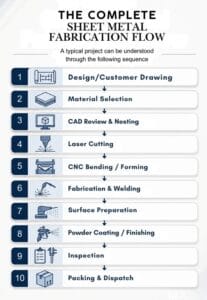
What matters is not simply whether every individual process is available.
What matters is whether those processes work together.
What Should You Ask a Sheet Metal Fabrication Partner?
When evaluating a supplier, price per component should not be your only question.
It is equally useful to ask:
· Can the supplier work accurately from our drawings?
· Which materials and thicknesses can they process?
· Are cutting and bending capabilities available within the same setup?
· Can fabricated assemblies also be produced?
· Are finishing services available?
· How is repeatability maintained across larger batches?
· At what stages are dimensions inspected?
· Can the supplier support both development and repeat-production requirements?
These questions reveal much more about manufacturing capability than a quotation alone.
A Finished Part is Only as Good as the Process Behind It
Sheet metal fabrication is sometimes reduced to three words: cut, bend, weld.
On the shop floor, it is far more interconnected.
The quality of a finished component depends on decisions made before the first cut, control during every manufacturing stage and an understanding of how each operation influences the next.
After working with industrial manufacturing requirements for decades, this is one principle we continue to see repeatedly: a reliable component is rarely created by one sophisticated machine.
It is created by a reliable process.
At Madaan Lasertech, we bring together laser cutting, bending, fabrication, powder coating and associated sheet metal manufacturing capabilities to help customers move from a drawing to a production-ready component through a coordinated manufacturing workflow. Our broader industry experience spans more than 40 years, supporting the practical understanding required for varied industrial requirements.
So, when you are evaluating sheet metal fabrication solutions in India, look beyond the individual operations listed on a supplier’s website.
Look at how those operations connect.
Because ultimately, you are not purchasing a laser cut, a bend or a weld.
You are purchasing a component that needs to fit, function and perform when it reaches your production line.