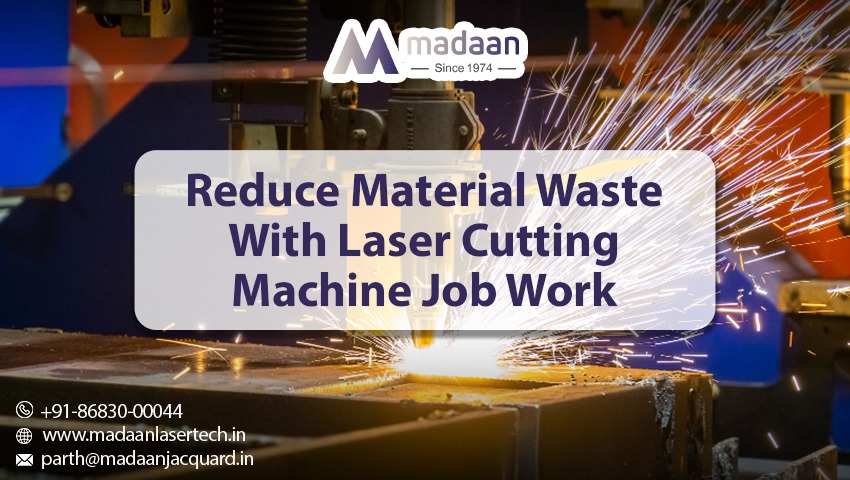
In the contemporary manufacturing environment, profit and loss are usually separated by a thin line between the quantity of raw material that is in the scrap bin. Due to the need to be sustainable and cost-efficient, more and more industries are moving towards high-precision technology as opposed to conventional cutting.
This blog will discuss how by outsourcing your Laser Cutting Machine Job Work to the services of professional service providers, you can reduce scrap and increase your bottom line by a significant margin.
What is Laser Cutting Machine Job Work?
It is necessary to know what the job work of laser cutting machine is before getting into the benefits of waste-reduction. Basically, this is a service model where the manufacturers or designers outsource their metal cutting needs to a dedicated facility fitted with industrial grade laser systems (CO2 or Fiber lasers).
The way Laser Cutting Job Work Minimizes Material Waste
The main objective of any fabrication process is to get the highest number of parts in a given sheet of raw material. The conventional processes such as mechanical sawing or plasma cutting are not always effective because of the large kerf widths and human factor. Laser cutting machine work resolves the waste problem in the following way:
1. Smart Nesting Software
The sophisticated algorithms of nesting are employed by job work providers. This software will accept the digital design of the parts you require and assemble them on a virtual sheet of metal in a complicated puzzle.
• Edge to Edge Cutting: Edge to edge parts may be positioned in millimeters.
• Common Line Cutting: Two components may be cut on the same line and the time and material are saved.
• Remnant Management: The professionals are able to fit tiny components into the gaps that bigger components have left.
2. Narrow Kerf Width
The thickness of the cut out material is called the kerf. In the conventional mechanical cutting, the blade thickness could cause a considerable loss. Nevertheless, a laser beam is extremely slender. You also get a kerf which is frequently less than 0.2mm by using Laser Cutting Machine Job Work, and this means that you can cut to tighter tolerances and the amount of dust or scrap metal is reduced.
3. Accuracy and Consistency
The most common reason of wastage of material is human error. It only takes one cut of a manual saw to destroy a sheet of costly stainless steel. Since the laser cutting is CNC controlled (Computer Numerical Control), the laser moves along the exact positions of the design each and every time. This gets rid of the reject pile and makes sure that all the material utilized is used to make a working component.
4. Reduced Heat Affected Zone (HAZ)
Conventional thermal cutting processes may distort the adjacent metal as a result of the overheating. This frequently causes border waste, in which the edges of the cut components are fragile or colored and have to be removed. The job work of the high-speed laser cutting machine focuses energy to the extent that the Heat Affected Zone is insignificant, and the integrity of the surrounding material is maintained.
Laser Cutting and the Old Method
To better understand the efficiency of the Laser Cutting Machine Job Work, let us look at how it compare to the older fabrication technique:
| Feature | Laser Cutting (Job Work) | Traditional Sawing/Shearing | Plasma Cutting |
| Kerf Width | Extremely Narrow (approx. 0.1mm – 0.3mm) | Wide (2mm – 5mm) | Moderate (1.5mm – 3mm) |
| Nesting Efficiency | High (Up to 90%+ material utilization) | Low (Linear cuts only) | Moderate |
| Edge Quality | Smooth, ready for assembly | Burred, requires grinding | Rough, requires cleaning |
| Error Rate | Minimal (CNC Driven) | High (Manual/Mechanical) | Moderate |
| Material Warping | Very Low | None (but mechanical stress) | High (due to heat) |
Diversity in the Industries
The beauty of the job work of laser cutting machine is that it is used in a colossal range of industries. It reduces waste, thus making specialized production more available to:
• Agriculture: Developing long lasting blades and parts of harvesters.
• Automotive: Making the complex brackets and chassis components with no room to error.
• Architecture: Cutting decorative facades and Jali patterns: In every millimeter of the metal sheet, art is made.
• Infrastructure: The cable trays and electrical panels need a high level of consistency.
Conclusion
Waste of materials is the taxation of your production process that is not required. When switching to Laser cutting machine job work at Madaan Lasertech, you are taking advantage of high-precision technology and high-expert nesting to make sure that every square inch of raw material is used. Madaan Lasertech, designed to transform the landscape, is a company that is based on innovation and sustainability. Our skilled workforce employs advanced, eco-friendly approaches to provide unparalleled quality in the automobile and aerospace industries, and each project fulfills the specific needs with the least amount of waste and the maximum performance.
FAQs
Q. What is the accuracy of the process for the laser cutting?
The systems that are run by CNC provide high precision and repeatability of each individual part.
Q. What is the benefit of Fiber lasers?
Fiber lasers are also faster and more efficient in cutting metal.
Q. Is job work more economical than machine purchase?
Yes, it does not require high capital expenditure and offers the availability of high-end technology.
Q. Which industries use these services to the best advantage?
The automotive industry, agriculture, aerospace, infrastructure and decorative architectural design industries gain a lot.